Unknown's avatar

About Janet Salbert

Always becoming a listener for God.

On Fecundity

DSC00299In Springtime, the air is full of earth’s fecundity. Robins dance as they build nests to fill with vulnerability. Blue jays hop along the bare branches full of last night’s rain dropping diamonds of light with every landing. Blooms begin to emerge in surprising places. Everything begins with beauty.

Beauty is sometimes easiest to find in a square inch; one raindrop, one robin’s egg, a newborn’s hands, and her mother’s smile. Sometimes beauty is found in large brushstrokes like the patterns clouds make in the sky at sunset, the steady stream of traffic that brings loved ones home after work, or fresh row of strawberries ripening in the sunshine. Beauty captures our attention in large masterpieces, too. A mountaintop view or a breezy balcony on the edge of the salty sea; an instrumental symphony, a choral harmony or the  sound of rushing waters over swollen rivers. Sooner or later the raindrop we encountered becomes the masterpiece. And, the fleeting beauty of choral voices bring us to notice one single Voice. The words of John Keats in an Ode on a Grecian Urn remind us, “Beauty is truth, truth beauty and that is all you need to know.”

It takes all our senses to receive beauty. It requires an open awareness to all that is. The more beauty we take in, the more beauty is reflected back for others. Practice fecundity.

Alive in Christ!

DSC00272                             Easter Sunrise, Woodlawn Plantation

Today we celebrate the Risen Christ! Today, we celebrate victory over sin and death! And here’s the thing: It doesn’t matter if we feel victorious or not, if we recognize Christ or not,  if we deny Jesus or accept him, it doesn’t matter if new life is part of our experience or if we are still waiting for something good to happen in our lives, because simply put, we do not accomplish the resurrection, God does that! And there is nothing we can do about it. God loves us and wants us all to have a full and meaningful life. The good news for the church, and the good news for you and for me today, is that any emptiness, any place of death in our lives, any life-sucking energy depleting circumstances, any illness or addiction we might be dealing with, could be the very avenue that God will use to bring us to new life.

Alleluia! Christ our Lord is Risen today!

I Thirst

DSC00214

I thirst.

It’s a hot 90 degree day, you have been working outside, covered in dust and dirt, smeared on your face and in your hair. You notice a garden hose, or a spigot,  water dripping out across the sidewalk, you reach down and pick it up, just a sip, just enough to wet your lips brings you relief.

Jesus calls out from the cross, “I thirst.”

Below him, someone steps up with a branch of hyssop and wine vinegar, and touches his lips.  Wine vinegar diluted with water was called posca, the drink of choice because it was thirst quenching, inexpensive and made river water more palatable. They soldiers at the crucifixion weren’t getting drunk on it, just using it to quench their own thirst.

Lifting the sponge soaked with posca with the branch of hyssop was necessary to reach Jesus’ lips. For those watching, the hyssop would remind them of the washing of the sacrificial blood of the lamb over the door posts in the Passover. Even in the midst of human failure and sin, here at Golgotha, a new Passover was being initiated.

As a nurse in the hospital, I had many occasions to put a cup of water, or straw to the lips of a thirsty patient, perhaps someone had surgery, or a stroke and could not lift the cup. I remember one patient in particular whose broken bones kept him from moving his arms and legs. Can you give me a drink? Thirst is the universal experience essential for sustaining all human life.

John’s gospel likes to point out the many ways Jesus’ humanity is revealed; he weeps, he gets angry, he thirsts. I think here on the cross however, when Jesus said, “I thirst,” rather than revealing his humanity, I think Jesus was revealing his full divinity. 

God on the cross, the divinity of Jesus exposed there, the love that held Jesus to the cross, became the liquid poured out for our sakes. It’s the water that is separated for our baptism, it is the water that brings forth the new creation. Jesus’ thirst fulfilled the revelation of scripture, Psalm 69:21 “They put gall in my food and gave me vinegar for my thirst.”

Rather than posca, the liquid Jesus thirsted for that is essential for life is love. And here’s the thing: on Good Friday, we acknowledge that the crucified God still thirsts for our love. What makes our love available to God, what quenches God’s thirst is our complete trust, our faith.  God thirsts for us to love God with our whole lives. Not just sharing ourselves a sip at a time.

There on the cross is not the only time Jesus asked for a drink. Do you remember Jesus in Samaria, “Give me a drink?” Jesus greets the woman at the well. He was certainly able to get his own drink. And the woman is already suspicious, what did Jesus really want? She asks, why are you asking me for a drink?

It doesn’t take long to realize the way to care for those who thirst is through a relationship. She has the longest recorded conversation with Jesus found anywhere in scripture. She accepts the truth he gives her and she is so transformed that she goes back into her village where she was an outcast and brings many out to meet Jesus. She has fallen in love with yet another man, Jesus.  She has fallen in love with truth, with the way and with the life.

This question, “give me a drink,” was the very question I heard when my relationship with Jesus deepened.  Why are you asking me for a drink? What kind of relationship are you calling me to?

What Jesus was asking the woman at the well for was this: give me what I am thirsting for most, let go of your past, your five husbands and give me your whole life. He told the woman, “when you drink the water I shall give, it shall become in you a well springing up to eternal life.” You see when God gives us water, when God gives us his love, love that is essential for life, there is none of this sipping out of a hose, God is like a three-year old and pours that water over us until we are drenched in love. God is the ultimate fireman, a big huge hose of water poured out to save our lives.

Jesus Christ thirsts for more than our doing good things for others, following Jesus means placing our full trust in his love that gives life.  Following Jesus means that our lives are filled with love. Our one single aim is to quench Jesus’ thirst on that cross, to relieve his suffering, to give him our love and our lives.  Your cup and mine, Jesus wants to drink deeply of the love that places our complete trust in him.
(Photo Credit, Casey Boga)

Neighborhood Landscapes

100_0574

I love driving into our neighborhood. The road passes over a creek, trees stretch their arms to the sky, and sometimes a hawk flies into view or deer stand still in the landscape. I have a sense of communion with each of our neighbors who are shaped and formed by this same landscape. We see one other daily while walking our dogs, driving to work, attending to our lawns and caring for our children. When the wildness of creation tosses a snowstorm our way, we shovel and share eggs and milk as needed. At times, the landscape becomes still and invites us to do the same. We share a common and connected life with our neighbors.

My active role in the church has given me another neighborhood to dwell in. We are clergy and laity, women and men who are shaped and formed by the particular landscape of tradition. The common life we share is under tremendous strain. We cross bridges and climb over fences in order to reach others cut off by social and cultural divides hoping to share the landscape of God’s love which we confess is so deep and so vast that even we cannot fully grasp it.

I am fully convinced that what the church needs, in fact, what the global neighborhood needs, is to practice resting silently in the One who shapes and forms us by grace, forgiveness and mercy. As we become part of that landscape, we might find our connected, common life is already here.

Good Grief

DSC00193I keep the names and pictures of the victims of Sandy Hook Elementary School on my desktop, alongside Thomas, Nick and Ryan, each one a friend of ours who died too young. When I look at these names and faces, mostly I think about their families who will always carry the grief of their loss. Some days, like mine yesterday, get hijacked; unexpected issues arise and I stop to think of those whose lives are forever interrupted.

Grief is unique for every person. Grief is not predictable. Grief encompasses a wide range of emotion, including anger. Even the closest family members and friends may not know what to say in the midst of our grief. We will need to forgive people often for comments that don’t seem to make any sense. We may not be able to express our grief to everyone, but it is vital to find a few people to share it with. Sharing our grief with those who have also endured a loss reminds us that we are not alone.

Perhaps most of all, in a culture whose emphasis is happiness, we need to give ourselves permission to grieve. Dietrich Bonhoeffer’s thoughts are helpful for me, “When we lose someone we love it is very hard, it is nonsense to say that God fills the gap, rather God leaves it empty so to keep alive our former communion.”

The loss of someone we love is very hard, but grief is good.

Every Bloom of Hope

DSC00162Sower of Blessing, who scatters goodness with abandon,
We breathe in your silent Presence waiting for hidden things to appear, as surely as seed bringing forth flower from the depths of the earth. Give us wisdom to notice each healing thought and every bloom of hope that surfaces. Draw us into the rhythm of your unfolding to join in the wonder of restoring your creation. Amen.

Pilgrimage

DSCN0220

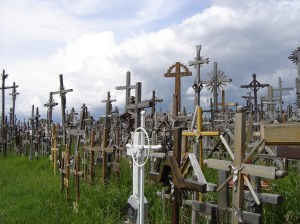
Celtic spirituality offers us some added disciplines to grow in our understanding of God’s faithfulness. For the ancient Celtic monks, pilgrimage was the art of leaving the comfortable and familiar of home to encounter God. Pilgrimage was often used as a way to share the gospel or to walk in the footsteps of a holy person.  Many Jews and Christians participate in pilgrimage by traveling to Israel. Pilgrimage to Mecca is one of the pillars of Islam. We do not need to travel to the place where our faith originated to accomplish pilgrimage. When on pilgrimage, the exposure to creation reveals the Divine Presence through plants, animals, landscapes and natural designs. Each person we meet on the road may carry a divine message.

Pilgrimage begins with preparation. Where are we going and why? We prepare our hearts and minds by establishing an intent, a reason for becoming a pilgrim. Do we have a yearning that needs to be addressed? Is it to watch for God’s Spirit in the world? Or is it to learn about faithful saints, or spiritual leaders? Preparing helps us to set aside other aspects of our life so we can give our full attention to the Spirit that beckons us on the journey. The act of physical packing only the essentials of what we will need is part of pilgrimage. During your time of preparation, be sure to plan a couple of stops during your pilgrimage to visit a special place or take time for reflection.

I believe that we can take on a pilgrim’s heart each time we leave home to accomplish our daily activities. If we leave home expecting to encounter God, there is a good chance we will be open to noticing God every day. No matter what the challenges of our circumstances at work or at school, with our health or our relationships, we can be pilgrims learning from those who walked the path before us. The best part of pilgrimage is bringing home the boon. What did we find while we were away from the comfortable and familiar? Sharing what we learn with others deepens our understanding.

During this Lenten season, I encourage you to practice the discipline of pilgrimage, leaving home for the unknown might open the path for an encounter with the Divine.